Friday, January 13, 2023

Masters- the first time

In an effort to get back in swim shape, having done little but paddle around since Alcatraz, and this being winter, I joined the local Masters team for a workout. This was my first time at a Masters workout in what I believe is 16 or 17 years. I don't remember my times. I barely remember how to flip turn, and I don't remember the order of an IM (I had to ask the coach!!). But I figured the worst that could happen is that I'd get out of the pool before the hour was over, so I decided to give it a try. 

I lasted the whole hour!

I wasn't able to keep up with the lane I was in, and since there was only one other swimmer we decided to split the lane rather than circle swim.

I took baseline times for my 100 free (2:40) and 100 breast (2:46). I know these are slow times, and I am almost hesitant to post them. But I also know that they will get better if I keep going, and if I don't post them, I won't be able to share how much improvement I have.

And the best part of the swim--- how I felt after. I was tired in a good way and felt IN my body, something I struggle with. I was relaxed. And happy. And that matters more than the time.


Monday, September 12, 2022

I escaped Alcatraz!!


TL;DR: I did it. I swam from Alcatraz.


The long story....

6am on September 5th (Labor Day) came early. I slept poorly the night before, up for about an hour in the middle of the night ruminating on the swim.  The doubts had started to creep in.  Was my "no plan" training plan really enough training? Was the jump going to scare me and I'd freeze? Was I just simply out of my mind for thinking my body could do a swim like this?  All the doubts crept in.  My friend Carrie had said to me that "once you jump off the boat, you don't have a lot of choice but to swim to shore". I kept that in mind, figuring I would take it one step (or jump) at a time and probably make it.

I know I'm a slower swimmer. I used to only swim breast stroke, but for this event I knew I'd need to do more freestyle (or crawl, as some call it), which is a faster stroke. So I trained about 60/40 free/breast with the hopes of having a fast enough time to not get "repositioned" by the event organizers. If you are unable to swim fast enough to make the currents, they will use a jet ski with a sled behind it to reposition you and keep you from being swept out to sea. I feared repositioning, but I also knew there was a chance it would happen, and I wouldn't fight it if it did.

After a quick breakfast of cheese and crackers, I met my friends Erin and Alex in the hotel lobby, and, along with my (camera shy, not on social media) spouse, we walked over to the start. (notice Erin's Nicholas Cage in the Rock custom swimsuit in this pre swim photo).


We did packet pick up, I wrote "It's my 50th birthday" on my cap, we lubed up with body glide, found the other Seattle swimmers who we knew (Heidi and Cheryl) and took in the atmosphere.  They made announcements about the course, telling us that it was probably the best conditions imaginable and to sight on the two large condo buildings that are just up from Ghirardelli square. They reminded us to jump and then quickly swim out of the way, but also to pause at some point and take in the beauty of San Francisco from the water. The water was 64*. The Bay Area was having a heat wave, with highs predicted in the 80s. The winds were calm, and I was too. I was surprised at how not nervous I was.  Everyone who had asked me if I was ready on the days leading up had gotten the answer "I'm waffling between being positive I can do it and being scared out of my mind." But that morning, I was calm.


The procession to the ferry was led by a bagpiper. We walked the four blocks through the city streets. I felt bad for those staying at hotels along the way. It was 8:00 and we were LOUD. 


Heidi had gotten us great seats on the ferry, so we could relax. The ferry ride was short, and as we arrived at Alcatraz, we saw the huge gang of kayakers, paddle boarders, and jet skis that would accompany us on the swim. They started to have us line up to jump, then said they were going to delay the swim 10 min while we waited for the Alcatraz ferry to dock and let off passengers.  We sat back down.  The conversation on the ferry was mostly about how beautiful of a day it was and how lucky we were. I started to get a little nervous, but figured I was pretty much committed at this point. The 10 min went by quickly and it came time to line up for the jump again. It was perfect, they wanted us in threes, so Erin, Alex and I could go together! (that's Alex's splash on the left, Erin Center, and me to the right). 


And then we swam, quickly, out of the way (you can see the next jumpers- Heidi and Cheryl here, I'm swimming out of the way top center, with Erin to the left of the frame)


The water felt cold, but not shockingly so. And as I swam out of the way, I thought, wow, I'm actually doing this (and that no one tells you about the swimsuit wedgie you get from jumping!!).  As Carrie said, there is nothing to do now but swim to shore.

The jump gave me an adrenaline rush, and I had a hard time catching my breath. So I decided to start breast stroke. I often ease into a swim with a lot of breast stroke (or swim the whole way breast) so it was a natural fit for me. I could look around at the other swimmers, the island of Alcatraz, the kayakers and the city, and get my bearings. After a few min I tried to swim free, but realized I was still panting, and needed to calm my breathing. So more breast. It took about three tries and five minutes for me to be able to recover my breathing and sustain free. But I did, I got a good pace going, breathing every second or fourth stroke (no, I'm not great at Bilateral Breathing) and sighting on the condos, which were easy to see from the water.

The crowd around me thinned out. I knew I'd be at the back of the pack eventually, and wasn't too worried about it. I chose this version of the Alcatraz swim in part because there was no cut off time. Occasionally a kayaker or paddle boarder would check in on me, ask me how I was doing. I always said it was a lovely day for a swim, and they'd agree. Once a swimmer coming at a different trajectory than mine almost kicked me in the face. I tapped her foot to let her know I was there. She apologized and swam on.

I tried to focus on reflecting on what it means to be 50, but I couldn't really hold a thought in my head. It was more "swim, just swim."

At one point there was a warm current, and immediately three large (dinner plate sized) and really beautiful jellyfish. I wondered to myself if this type of jelly stings or not. They looked like the kind from Puget Sound that don't sting, but I didn't know for sure if they were the same or not. (a quick google search now shows that they are probably the same genus but a different species). They were awe inspiring, and, because I didn't know if they sting or not, a bit frightening. Every time, for the rest of the swim, that I went through a warm current, I'd look for them.  I didn't see any again.

I thought about my family that had come to San Francisco to cheer for me. My parents, cousins, and spouse. I went through each one, thinking about how much I love them, and what they mean to me.

I did stop, three times, to look at the view and admire the city. I thought about my grand mother Estelle (of blessed memory) who taught me at a young age which island was Alcatraz from her window on Gerry street. The Transamerica Pyramid, Salesforce Tower, Coit Tower, and both the Golden Gate and Bay bridges were visible. The skies were clear, and the city was beautiful.

About two thirds of the way from Alcatraz to the Aquatic Park entrance, a kayaker came up to me and asked me how I was doing. I replied that I was fine. He said "you are a bit off course, so we are going to assign you a swim angel to swim with you, and we are going to reset your course".  Over the next 20  min or so, they proceeded to change my sighting point no fewer than 8 times.  The condo buildings, the wall that is around the Aquatic Park, the middle mast on the sailboat, and the entrance to the Aquatic Park all became sighting guides at some point. 

At first I resented the help, wanting to do it myself. Then I realized that all good distance swimmers have a team, including an excellent boat pilot to give them the shortest swim line possible given the weather conditions. So I came to appreciate them. Zach, the swimmer, and the kayaker whose name I never learned. Zach was able to pace me doing breast stroke (to my free) and he'd communicate with the kayaker, who could see the impact that current had on swimmers ahead of me, and tell me when to change course.  The currents in this part of the bay are often what Heidi calls "frogger" currents, coming first from one side, then from the other, in such a way that swimming a straight line is not possible.

With Zach at my side, I did a lot less breast stroke than I'd anticipated doing. I started to feel my neck chafe and tried to adjust my swim cap, but realized it wasn't the cap rubbing, but skin against skin instead. Not a lot I could do about that.

With a strong push through the west sweeping current, I entered the aquatic park. I turned to thank Zach and the Kayaker, but both were gone. On to help another swimmer I guess (just like Pete's dragon!). 

Once in the Aquatic Park a kayaker said to me "only 200 more meters to go". That's great, but since I haven't been in a pool since COVID, I have no real sense of how far that is!  The currents were stronger in the Aquatic Park than I'd expected them to be, but I pushed on. Did a little breast stroke to help my family identify me, and swam in.  As I rounded the sailboat parked in the middle of the park, I saw the famous Ghirardelli Chocolate sign from the water. I knew that a LARGE ice cream was awaiting me that afternoon.


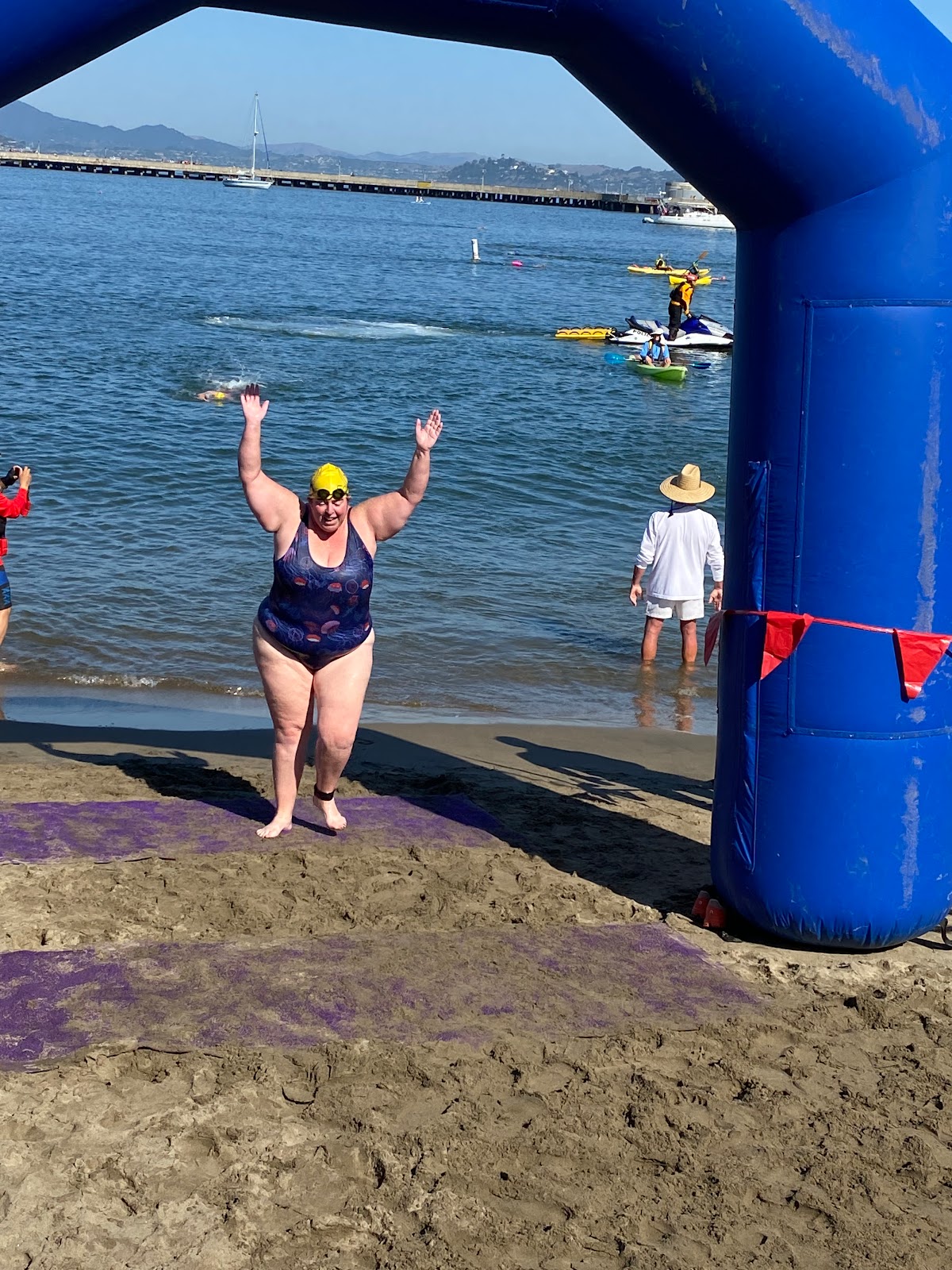
I could hear the folks on shore yelling. I even heard a "happy birthday" as my feet touched the sandy bottom and I ran out of the water.


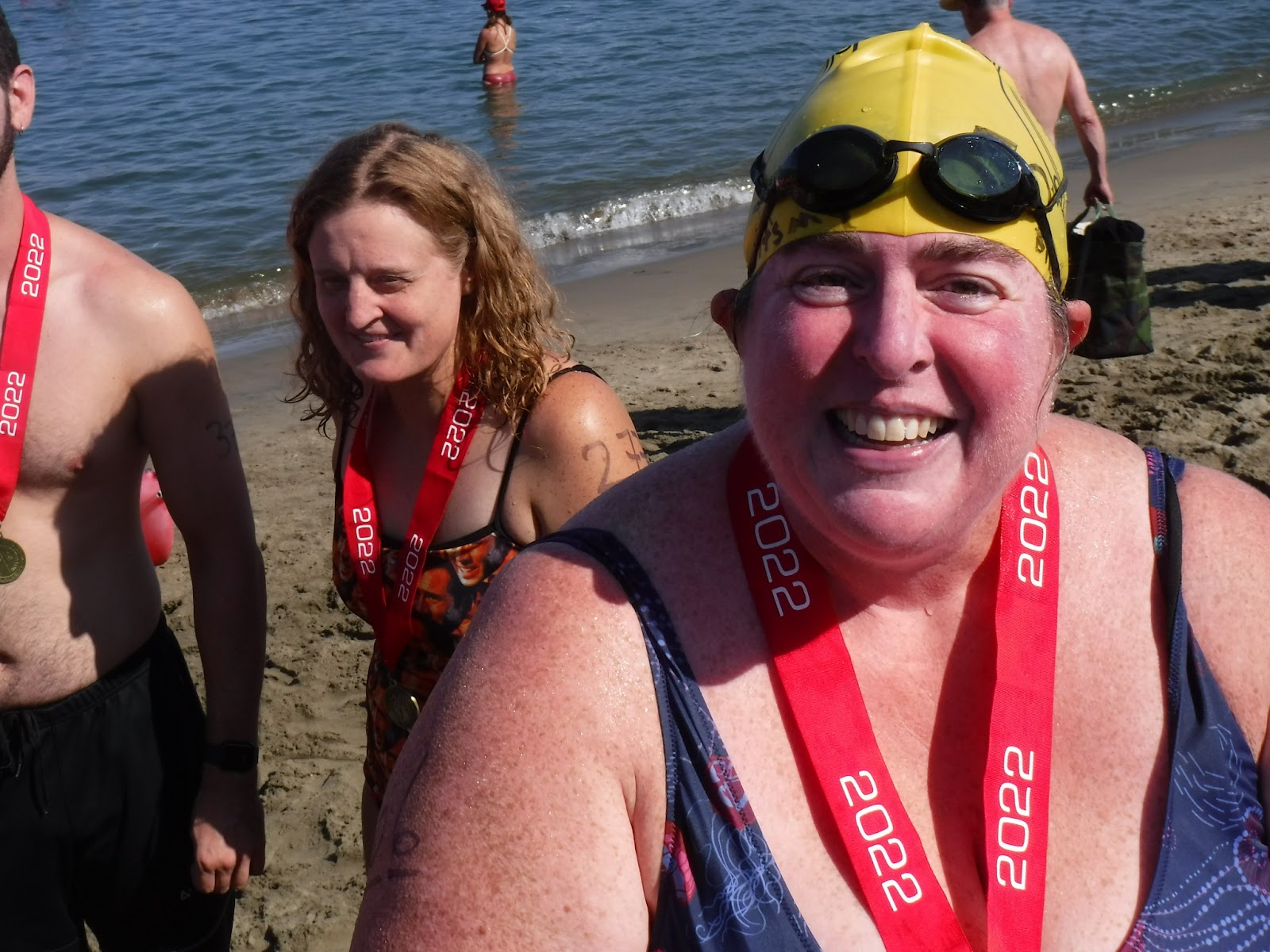
There were folks there to help me off with my timing chip, and to give me a metal! And more importantly, there were my parents, spouse, cousins, and friends all there with hugs and high fives.

I was strong coming out of the water. Not disoriented or dizzy at all. Other than the chafing on my neck, there was no ill effect. My body was TIRED the rest of the day and most of the next, but I was able to walk through Fisherman's Warf and hang out with friends and family. 


All those middle of the night doubts were for nothing. I was able to do the swim, finish in almost the time I predicted (I predicted 90 min it took me 94- and generally times were slow this year), and love every minute of it. This is what 50 looks like!


Wednesday, August 3, 2022

The no-plan training plan- Alcatraz Edition

Historically, when I've set a goal for a sporting event, I've created a detailed training plan and followed it to the letter. I've done heart rate training for running, and tracked my zones with precision. In prior years I set training goals for various events.   For reasons I won't get into here, that rigid planful type of training doesn't fit my current life and psyche. 


So for Alcatraz, I've set a no-plan training plan. Instead of rigid goals, I've set mild benchmarks that if I make them, I know I'll be on track for the swim.

The first benchmark is to swim three or more days a week, except when I can't. (How's that for a non-rigid goal?) Last week I was in Victoria, BC with the spouse for four days. I didn't swim at all. That's ok. When I came home I picked up my Tuesday-Thursday-Saturday swim routine, having only missed one Tuesday.

The second benchmark is to make a mile an easy swim. I've accomplished this. It is about a mile from the swim beach to the dog park and back at Magnusson park, where I swim most often. That is now my "daily" swim or my "easy" swim.  When I don't feel like swimming, I do that mile. Easy peasy.

The third benchmark is to make a mile and a half an easy swim. I've pretty much accomplished this. I've done the mile-and-a-half swim three times, and only the first time did it feel hard. It is worth  noting that the first time was also the worst conditions I've swum in so far this summer.

The fourth benchmark is to swim to the Lighthouse and back every time I swim at Alki in July and August. I've done this this last two times I've swum at Alki (so far every time in July and August). The distance is almost identical to Alcatraz, though the conditions may be different. 


The final benchmark is to make a two mile swim a reasonable swim, if not "easy". I'm still working up to this, but plan on doing my first two miler of the season this Thursday. If I can do it once a week between now and Alcatraz I'll consider the benchmark met.

Just over a month until the Alcatraz swim, I've made four of my five benchmarks. I'm on my way!

Practicing the Jump- Part 2

 Those who read here regularly may know that I have a bit of anxiety about the start of my upcoming swim from Alcatraz. So a few weeks ago I practiced jumping from a four foot height into the water. The other aspect of the jump that has me anxious is the temperature.  I swim in Puget Sound year round, so the water temperature isn't such an issue. But I generally take my time getting in.  In fact, my spouse has recorded me taking over 20 min to get in!  I'll wade in up to my waist, then procrastinate. Splash myself. Procrastinate more. Question all the life choices that led me to this moment, and procrastinate more. Then slowly ease myself into head up breast stroke, only putting my face in the water when I've warmed up.

The Alcatraz swim will be a jump, from the boat, followed by immediate swimming. No 20 min warm up and gentle head up breast stroke.  So although I'm used to cold water, I was a little worried about the cold water shock.

So my partners in crime for the swim, A and E, and I decided to practice jumping in to cold water.  We couldn't find a safe public jumping dock in Puget Sound, so we decided a paddle board would work.

A brought his inflatable and went first.  He paddled out to a reasonable depth, stowed the paddle and jumped in. E went next. I waffled over doing it or not, changing my mind about 12 times. It wasn't that I was afraid of the cold water shock, though it was a little that, but rather that I wasn't sure about the paddle board, as my knee is not great for getting up off the floor.  Then I realized, the whole point was to fall, so if I fell while getting up, well, I'd get the cold water shock experience just a second or two earlier than planned.

So I paddled out, stowed the paddle on the board, and jumped from my knees (a compromise on the "can I get up?" issue). The water was cold, but refreshing. It reminded me of my childhood, jumping into spring fed creeks. And ultimately, like the jump from height, it just wasn't so bad. The water in San Francisco Bay can be as much as 10 degrees warmer than Puget Sound, so that jump will be even easier than this one was.

I'm one step closer to Alcatraz.

Wednesday, July 20, 2022

Practicing the Jump

One of my fears, in getting ready for Alcatraz, is that I have to jump off a boat for the start.  I'm afraid of heights (see my historic fear of flying) and although landing in water is comfortable, the "fall" part of the jump isn't.  So I did what any afraid person would do, I researched the heck out of it, then I practiced.

First, I looked through photos of last year's swim, to get a sense of the jump distance.


 The roll shows a HUGE ferry, and the jump, two or three people at a time, of what I'm estimating to be four feet. Four feet isn't a huge jump, but it also isn't my typical "wade in to my waist then wait until I'm ready to swim and ease in to head up breast stroke" way of entering the water. This jump was something I needed to know more about.

So I grabbed my two partners in crime for the swim, E and A, and headed down to Green Lake to the diving boards to practice the jump. We estimate that the low board is about four feet above the water. 


Our plan was to get to Green Lake at 7 as the lifeguards went off duty, in hopes that it would be quiet and we could jump multiple times in peace. Boy were we wrong. The place was packed. On a day that was over 80* in Seattle, we shouldn't have been surprised.  We waited a while, watching the kids go off the boards, and the adults who were playing water polo in the lake. Then we got in for our turn.

I decided I had to do it without too much thought at the end of the board, or I'd chicken out.  In truth, it wasn't as high or as scary as I'd feared. 

The first jump I got water up my nose, and in my goggles. Up the nose isn't pleasant in Green Lake (ick) but would be worse in salt water (ouch!). And the goggles weren't so water logged that I couldn't at least swim out of the way of others before clearing them. 

I jumped again. Water up the nose, and in the goggles.  Tightened the goggles a little, and jumped again.  They stayed secure, but water up the nose.  Held my nose, jumped again. Bingo. That's the magic combination.

My hair is about to my elbows right now, so I have a pretty big bun in my swim cap. Having one of the goggle straps below the bun keeps the goggles from coming off on impact.  And holding my nose, well, it keeps water out of my nose on impact.

The four foot distance wasn't that bad. I needed to not really pause at the edge, but just take a second to check that the water below was clear and jump. Doing it fast kept the fear from seeping in.

Now off to find something else to obsess about for the swim.

Wednesday, May 18, 2022

Fear of Breaking Waves

I've been swimming since I was little. But as a little one, my ocean swimming was off the coast of North Carolina, where I grew up.  I remember many a summer at the beach, playing in the water, and getting swept off my feet by breaking waves. The feel of tumbling in the ocean, unsure which way was up or down, with salt and sand in my eyes and nose taught me to fear the breakers.  That fear has stayed with me as an adult.

Luckily, where I swim now is usually protected and fairly calm.  Usually. Until it isn't. Like the day I'm writing about today, where there was a strong north wind. And a high tide.  And that led to three foot waves at Alki.  And Breakers. It was a day like this:


But this story isn't really about breakers. It is about friendship.  There is a guy I swim with named Jerome who is the "dad" of the swim club. The unofficial greeter, babysitter, lifeguard, bouncer, security agent, and cheerleader, among other things. He is an accomplished swimmer in his own right, having done an ice mile and the swim from Bremerton to Alki (a 10 miler). 


Jerome knows I'm afraid of breakers. And on the day in question, he said he'd get into the water with me, talk me through it, and help me get to the other side of the breakers, where I could play in the waves, or swim.

So I waded into the water. And immediately felt the force of the waves and the cold spray on my chest. I backed off, out of the water.  Jerome called to me. "Come on in, Rebecca, you can do it". And I inched deeper back into the water. I felt like I would drown. I felt like I would cry. I felt panic set in. I backed off again. And started in on the self talk, bargaining if I made it past the breakers for 30 seconds, I could consider it a "swim" for the day.  "Reebs," I said, "you can do this. Just do it." It didn't totally work. I turned toward Jerome for help.

Jerome is a large man. Both tall and broad shouldered. So he stood in the waves, literally letting them break over him before they hit me, and slowly walked me into the ocean. On the third try I was able to do it. I still felt the force of the ocean. I still had the cold spray hitting my chest and face. I still had the fear. But I also had the friendship, and someone rooting for me.

Triumphantly, I made it past the line of breakers and into the churning ocean. I swam for 30 seconds.

A true friend will try to hold the ocean back for you.


Training Goals

I grew up with San Francisco being my home away from home. My grandparents, aunts, and uncles all lived in the greater Bay Area, and I was out there visiting annually, at least. 

My Grandmother had a flat on Vallejo with an amazing view of the bay. It was there that I learned that Alcatraz was the one on the right and Angel Island was the one on the left.  I used to walk through the tourist areas in Fisherman's Warf and Pier 39 and admire the Alcatraz Swim Club t-shirts, understanding the joke that swimming from Alcatraz was impossible.

This September I will turn 50.  So I will attempt the "impossible". On September 5th, if all goes well with training and this pandemic we are living in, I will swim from Alcatraz to the San Francisco Aquatic Park.


The distance is 1.22 miles. Of course it is impossible to swim it that straight. But if one could, it is shorter than the Park to Park that I've done often.  The current could also be impressive that day, making it harder than anything I've done, including Swim Defiance

So the plan is to revamp the blog, and follow my summer of training for Alcatraz!!!

Wednesday, July 28, 2021

#2 Challenge

 One of my  most frequented posts on this blog is about peeing in the pool.  This isn't that.

About 6 months ago, a friend issued a #2 challenge. The first to complete the challenge during a regular weekend swim at Alki would win $5 from the other participants.  The challenge was won, about three weeks later. Not by me.

But this week I completed the challenge.  And I have a few tips.  It is easier in a "seated" position, not a swimming position. Pull your bathing suit WAY to the side. And make sure you are away from others.

Not a challenge to take every week. But I'm proud to say I'm #2.

log in the water


Monday, May 11, 2020

Swimming through the Lockdown

I've been working from home for nine weeks now, and my state has been on a "Stay at Home" order for almost as long. Pools are closed. And I'm antsy. To add to the difficulty, the main bridge between my house and Alki beach, where I swim in the Sound, is closed for repairs, indefinitely.  So I head to my little local lake- Green Lake.


This little, 5k circumference, lake, is about 60* now. I swim from the Rec Center to the Bathhouse and back, an approximately one mile route. At 60* I swim skin and have a few observations from my swims.

Sixty is cold enough to get chilled, but not cold enough to go numb. So I continue to feel cold through the whole swim. However, I re-warm after far faster than I do in the sub 50* Puget Sound.

There is a lot less interesting to watch in the fresh water lake than there is in the salt water Sound. No seals or sea lions. No crabs or starfish. I did see a turtle. And often see large fish.


And the most important thing I've noticed, swimming in Green Lake.... It makes me happy. It may not be Alki surrounded by friends, but a good hard swim makes the day better regardless.


Open Water Swim FAQ

I wrote this FAQ for my Open Water Swim Facebook group.


Welcome to the Western Washington Open Water Swim Facebook Group.  The FAQ below is to help you get started in Open Water Swimming. Feel free to read it and then ask questions that aren’t answered here.  We are a social group with a swimming problem and always happy to meet new swimmers or potential swimmers.

Where do I swim?
Almost any body of water can be a swimmable body of water.  Some of the more popular places to swim around Seattle include:
Alki beach- start at the bathhouse and swim to the lighthouse and back
Golden Gardens- beware of strong current around the point to the north
Greenlake- Start at the bathhouse and swim to the rec center and back, or vice versa
Lake Smammish
Lake Washington- Madison beach is popular, swimming south, away from the 520 bridge. People also like to swim around the Seward Park peninsula. Much, if not all of Lake Washington is swimmable
Martha Lake

Wherever you swim, start out swimming parallel to shore and don’t go too far from your exit point. You can always do “laps” if you want to swim longer.

What do I wear?
At a minimum a bathing suit, cap and goggles are necessary.  Brands and styles of all of these are a matter of personal preference. Buy what you can afford, and don’t sweat fashion too much. Once you are in the water, no one really sees what you are wearing. The exception to that is the cap. A BRIGHT colored cap makes you more visible to boaters and other swimmers, and adds a degree of safety to your excursion.

Additional gear you might like:
Wetsuit- buy a suit designed for triathletes so you have the most mobility possible while swimming. These are usually thicker (3-5mm) on your torso and thinner (1-3 mm) on your arms. Some people think a wetsuit is essential for the temperatures in our waters here, others find them too restrictive to swim in.  It really is a matter of personal preference and no one can decide for you if a wetsuit is needed or not. Long or short on the sleeves and legs is also personal preference. Buy what you can afford and what makes you feel safe and comfortable. Blue Seventy is a local to Seattle company. Xtera also makes triathlon wetsuits.  One swimmer said this about wetsuits: “For me wearing a wet suit makes me feel warmer and I swim faster. Going skin makes me feel tough, strong and determined. Both choices are good things.”

Neoprene booties and/or gloves- like the wetsuit this is a matter of personal preference. They are pretty easy to find at the local dive shops, and often are made by major wetsuit manufacturers. Blue Seventy for example.  They will keep your feet and hands marginally warmer.  Booties also will protect your feet from all but the sharpest of debris on the ocean or lake floor.

Neoprene cap- some like to wear a neoprene cap to keep their head warmer. These also are available in dive shops, and often have a strap that goes under your chin. Most neoprene caps come in black, so folks still wear a brightly colored latex or silicone swim cap over them for visibility.

Earplugs- for some reason earplugs can help with both warmth and potential motion sickness for swimmers, and are therefore highly recommended. They also may help prevent some types of swim related ear infections. You can buy waxy ones at local drug stores (Bartells, Wallgreens) or you can buy swim specific earplugs from swim stores.  The goal is to keep water out of your ears. They do reduce what you can hear while they are in.

Swim Buoy- This is a brightly colored inflatable buoy that you wear tethered to a strap around your waist. The goal of the buoy is to increase your visibility in the water, so boaters, other swimmers, and/or your friends on shore can spot you more easily. Some buoys come with a dry bag feature, so you can take valuables (car keys, phone, etc) with you and not leave them on the beach. These buoys are inflatable, so are not life saving devices, but can be used to support a swimmer who needs to adjust equipment or take a brief rest.

Anti-chaffing cream- Body Glide, Vaseline, zinc oxide or similar may be useful for you if you are going for longer swims and/or swimming in salt water. Put it any place your skin might rub with other skin or with your gear. Wetsuit swimmers often have issues with their necks. Skin swimmers with their armpits.

How do I handle the cold?
The best tip for handling the cold is to take your time to get used to the cold.  That means starting with a shorter swim than you might think—10-15 min without a wetsuit, 15-20 with—and working your way up. You may easily swim an hour in the pool, but the outdoor waters in the Pacific Northwest are much colder than your typical pool, most of the year. Your body will, over time, acclimatize to colder waters, and you will be able to swim for longer and longer.  Start slow.

The second tip for the cold is to get out of your wet gear as quickly as you can after you get out of the water.  Don’t plan to drive home in your bathing suit. If there aren’t changing facilities around, wrap a towel around you and do a “deck change”. Staying in the cold wet suit (especially women’s one piece suits) will continue to chill you.

Everyone has their own routine for re-warming after a swim. Many enjoy hot beverages, hot showers or baths, small microwaveable or chemical heat packs (like you would use for an injury) placed on their core, or exercises for the large muscle groups (squats, burpees, etc).

How do I stay safe?
There are no promises of safety in Open Water Swimming.  These are things you can do to reduce your risk:
Swim with a friend, or have a friend spot you from shore.
Swim parallel to shore.
Wear a bright colored cap and/or tow a buoy to stay visible.
Let wildlife have the right of way- we are visiting their home turf, don’t pursue or touch animals.
Be ready to re-warm when you get out of the water.
Use your best judgement, when in doubt, get out (of the water). If you think you are too cold, the animal is too close, the waves are too strong, or whatever, turn back and get out. Better to live to swim another day.

Tuesday, September 3, 2019

Labor Day Swim 2019- Fort Worden State Park

Every year my friend group and I get away for Labor Day. I've always tried to build a swim into this adventure.  This year was no different.

After last year's experience, leading a strong friend into harsh waters, I was very cautious with where we were going to swim this year.  I scoped out a lake, that ended up having toxic algae, so it was a no go. Then I found a city park, but the beach didn't slope down enough to swim.  In the end I found my way to the Fort Worden State Park.

The beach was ideal for swimming. The drop off is fairly steep, so you can be near shore and in plenty of water to swim. The swim area is mildly protected by the curve of the shoreline out to the light house point. And the temperature, though mildly colder than Alki, was warm enough. The red area on the map below is where I swam. You can see the protection the point gives.


Two of my friends took out an inflatable dingy, in the same water, and tooled around for a while while I swam.  The 10 year old "dunked" but found it too cold to swim.  As you can see, I was all smiles before the swim.


I was able to go for about 40 min. The currents were fascinating, pushing me towards the dock when I was near the dock and towards the lighthouse when I was near the lighthouse. It ended up feeling like I was always fighting the current.

After, I spent time on the beach shooting the breeze with my friends, a great way to cap off a swim!

Monday, March 25, 2019

GPS data from swim

I mentioned a few weeks ago that I got a new to me GPS system to track swims.  I'll do a full review of it in the future, when I've used it a bit more, but here's the data from this week's swim and a little about why it is interesting. (really, when is data not interesting?)

First, the GPS provides a map of the swim, with a heat map for pace.


The swim was a simple out-and-back to the third staircase. I was just shy of 800m with 16 "laps" of 50m each (the last one was 47m).

I like seeing how straight my swim was, and where I turned around (a bit past the third stairs). I would like to be able to zoom in a bit more. Which the ap doesn't seem to have the ability to do.

Now the more interesting stats:


That's my pace (in yellow) and my stroke rate (in pink).  Even if you can't read the numbers, you can draw a few conclusions about my swim.  The biggest one is current.  Knowing I turned around half way through (out and back swim) you can see what the current did to my pace. Sloooooowed it down!!  And, to compensate, about 100 m later, I picked up my stroke rate.  I must have realized I was going slower, or just wanted to finish.

I find the very high stroke rate for the first 100 m also very interesting.  That must be a response to the cold and wanting to just MOVE to warm up.  I don't think I realized it was that dramatic. I will want to see if that data is repeated in future swims.

I was having such a good time out there, that my 32 min earned me the "last swimmer" out there award this week.  Here's a shot a friend got before I got out.


Friday, March 22, 2019

Awakening the dolphin

Last night I went to an amazing panel discussion on women in open water swimming. It was, appropriately, called "Awakening the Dolphin Within".


Four of my incredibly talented and accomplished swim buddies served on a panel to discuss everything from training plans to how to pee while swimming. It was sponsored by Guila of Say Yes To Life swims.

The super cool aspect of this panel was that, even though I know these women, swim with them, and rewarm with them over donuts on a regular basis, I learned a ton and was inspired by their stories.

They spoke of training plans.  The hours they put in.  For an English Channel crossing, Melissa trained 35 hours a week. That's a full time job! Learning to understand what pain was "back off" pain and what pain was "suck it up cupcake" pain was important. From this I can take away two things.  One, I never want to swim the English Channel (this is not news). And two, I can learn when to push through pain.  I'd been reflecting on this question even prior to the panel. My sprained ankle back in September left me in a boot for 10 days, and with severe atrophy of muscles and weakening of my ankles and knees after.  I'm in physical therapy now to correct the issues. I've realized that I tend to respond to any pain with 100% rest.  I plan to talk to my physical therapist about when I should be doing active rest, or even pushing against the pain.

They spoke of bodily functions and swimming.  One of my most viewed pages in this blog is the one about peeing in the pool. I didn't realize, until this panel, that some folks struggle to pee while swimming. This has never been an issue for me.  There was also a discussion of #2 and of menstruation and sea life.  I did learn that it is better to have people see you poo than to get pulled for stomach cramps. AND blood and pee are the same to sea life, so if you can pee while swimming, you shouldn't sweat your period.

They spoke of the ways that swimming helps with depression.  I don't want to tell someone else's story about this topic. I do agree that sometimes, the water is the only place that the world make sense.  Major stresses can be solved by a good swim.

For me there wasn't a call to action, so much as a pointing out of how lazy I sometimes am about my workouts. If I were to push a bit harder, what could I accomplish?  This has especially been on my mind this week because I did a mile in the pool on Tuesday.  It took me about 8 min longer than I expected.  This is a huge slowdown.  And I want to get back to the speed I believe I can swim-- or even faster.  To do so, I'll need to work harder.  To swim faster you have to swim faster. It may be time to kick back into "training" mode.

I'm glad I spent my evening with these lovely and accomplished ladies. It woke up my dolphin!

I'll post the video when it is available.

Tuesday, January 15, 2019

Viadoom Swim/Walk

Usually I swim with the Notorious Alki Swimmers for my weekend swim.  As the name implies, we swim at Alki beach. Seattle is now, in the midst of "Viadoom" while, for three weeks, the Alaska Way Viaduct is closed and the replacement tunnel is not yet open.  I'll skip the politics of this in this forum, but suffice it to say, the impact on traffic, city wide, is anticipated to be significant.

I usually take the viaduct to Alki (or home) and so planned to meet up with a few north-end swimmers at Golden Gardens instead.  Three of us showed up on a beautiful, sunny, flat day.  The water was clear, and the sun was out. I almost worried about sunburn!


Golden Gardens is known for having a bit of a current as you swim around the point. I'd done it many times before and, although I'd felt the current, it had never been an issue.  Until this time.


I also have a new toy (I'll post on that soon) that is a GPS and gives me real-time auditory feedback on my pace. This ended up being very helpful, and a great safety tool, in this situation.

As I got used to the temperature, and started getting into my pace, the GPS was telling me that my "laps", which I'd set to 50 meters, were about 1:09 to 1:25.  I knew this was fast for me, but since I usually swim in a yards pool, it was hard to track how fast.  The swim was easy. I was watching the beautiful sand and sea floor. I had a goal of about a  mile, but after 650, the other two swimmers were coming back, so I turned around with them.

The next lap jumped from 1:20 to 2:20 then to 4:20. I wasn't sure, since the GPS is new to me, if this was a sign of the current, or of the GPS malfunctioning. You can see the change in pace around lap 11 here:


Either way, I decided that it was safer to start swimming towards shore, so I'd be closer in if I needed to bail.  This was a good idea.  It took me minutes to get near shore. And then, the current was pushing me so hard that my slowest 50 m was over 5 min! I got close it to shore and started to walk, in shoulder deep water, to see if I could get free from the current.  I couldn't.  But I tried for a few min.  I realized I was making no progress, so I got out, and walked back to my gear. My friends met me half way back with my shoes and towel. You can see my route here:


Notice that the color of the line is an indication of pace.  The green is faster than the blue. The darker the blue, the slower I was going.  Basically, from the turn around spot, I dramatically slowed down.

What did I learn from all this?  

First, swimming with friends is a good idea, I knew they were watching out for me and aware of where I was.  

Second, the GPS ended up being a real safety device. I wasn't sure I'd like the every 50 m updates, but in this case, it highlighted for me much quicker than I would have noticed alone, that my pace had dropped dramatically. 

Third, the habit of swimming parallel to shore is a smart one. I knew if I couldn't break the current, I would be able to turn around and swim across and with it to shore. Another safe choice.

Finally, once again, I got into an uncomfortable situation and got myself out of it safely.  As I push my limits swimming, I need to also balance that with swimming safely. This was a good test of my response intuition and I'm proud of how I responded. I never felt unsafe. I was confident the whole time that I knew what to do.  That was a good learning experience.

And really finally, there is no shame in walking.  I don't regret it. And I still think of this as a fabulous swim. Every swim teaches me something new.  This one was about current, and planning.


Friday, January 4, 2019

New Year Swim- 2019

People like to spend New Year's day doing something fun, unusual, or signficant.  New Year's 2000 (Y2K-- remember when we worried about that?) I started a 5 mile run at midnight. The motto was "Y2K can keep computers from running, but it can't keep us from running", but probably phrased in a catchier way.

As has become my habit, this year was started with a wonderful swim at Alki with the Notorious Alki Swimmers.  We had large turnout. Bigger than a usual weekend swim.


This is my fourth winter swimming at Alki. I have made wonderful friends along the way.


I'm not one to make resolutions. I gave up the diet mindset years ago. And in general I eat healthy and am not one to overspend. I also have realized that setting mile goals for a year can lead to injury.

At the same time, my goal from however many years ago, when I started this blog, was only accomplished when I joined a community.  This year, if I make it to spring, it will be accomplished four-fold.

Thank you to this wonderful community for helping me get there. And Happy 2019 to all!

Wednesday, December 26, 2018

If the Whale can do it, so can I!

This Saturday I woke up not wanting to swim.  I didn't want to get out of bed. It seemed like too much of a hassle.

BUT, I had promised a friend that I'd be there, and say hello.  So I got out of bed. I wasn't sure I was going to swim, as I just wasn't feeling it. BUT I put on my swimsuit, just in case.

I got to the beach, and told my friends I wasn't feeling it. I didn't think I was going to swim. I've shown up before thinking I wouldn't swim, and always did. But this time was different. I just didn't want to.

We posed for the photo.


Then, folks started getting ready. I did not.  I drank more of my hot chocolate. Then, someone yelled "Orca!".  Immediately, everyone turned toward the water-- scanning for any indication of a whale.

And there it was. Not an Orca, but a Humpback.  I watched it surface a few times. I saw the blow. It was beautiful, and swimming.

I figured, if the Whale could swim today, so could I.

So I did.


Tuesday, December 11, 2018

Being Present in my Body

As a larger woman, or perhaps as a woman, or perhaps as a human in today's world, it is easy to disengage with one's body.  There are so many messages about what a body supposed to be or look like, that one has two choices: spend a lot of time feeling disappointed or guilty for not reaching those goals, or disengage from one's body.

The water has so many tactile sensations, buoyancy, flow, cold, salty taste (or chlorine), particulate (hopefully not in the pool). I can feel my leg hair, the tightness of my goggles, the movement of my muscles. I hear each breath. The splash of the water.

This past weekend I listened to see if breast stroke sounds different from crawl.  The breathing and bubbles do. It is harder to tell about the sound of the water, as when one puts their head under, the sound changes.

When I get out of the water, I am present in my body. The messages about what it is supposed to look like are irrelevant.  What matters is what it feels like and what it can do.  I have an amazing body.


Thursday, November 29, 2018

Swimming with the fishes-- Waikiki again, but the true on this time

The spouse and I decided to spend Thanksgiving in Hawaii. Probably the best decision I've made in a long time.  This was the view from our hotel room balcony:


That's the Waikiki harbor, with an excellent perspective for sunsets, though I think we watched all of them from the beaches.

As the swimmer that I am, the highlight of the trip was swimming with the fishes!!  Hamama State Park has a nature preserve in it with amazing coral reefs.  You take a bus out to the park, pay the $7.50 entry, watch a 9 min video on safety for you and the reefs, and then walk down a hill with this view.


And this one:


You can see the shape of the reef from above.


Blue water is sand.  The reef is the darker area. It was great to see this view of the reef, because it was a map of what I would swim through, and really helped me get my orientation.

I own snorkel gear. In part this is because I want my prescription goggles. And in part because using a snorkel that has been in someone else's mouth is ick. 


I was one of the few with a swim cap on. Combine that with the Yellow rash/sun guard, and my orange buoy and I was easy to spot while swimming!

But what really mattered was what I was spotting.


The highlight was the sea turtles.  Day one I had a turtle almost to myself for 20 min.


We had a good long conversation about turtle-y things.

But the second day, the turtle had paparazzi.


This made me sad. Although, technically, the guy was within the rules-- he was not touching the turtle-- he was awfully close. The turtle was swimming away from him. Unlike the one I'd made friends with the previous day, who was happy to eat and talk to me.

I easily spent two hours in the water each day.  When the wind would pick up, the conditions would get worse, and I'd get out for a while and hang out on the beach. It was such a pretty place, easy to spend a day.

Another highlight of the trip was the drive to the North Shore, where we watched surfers at the Bonsi Pipeline. 


And met some beach chickens.


And I drove a VW Bug Convertible.  Wow I had a hard time giving that car back.


After so much sun, and 70* ocean water, the return to Alki will be hard!