Back in the water after two weeks off for my Flying Clinic. It was HARD to get back in. Getting into the cold water really is a mental game. It was like all my mental fortitude was gone. Perhaps I used up all my emotional and mental strength on the flying. As I stood there, contemplating the water, waist deep, I even said, "I confronted my biggest fear last weekend and now can't convince myself to get into cold water this weekend." I seriously contemplated getting out. But I want to participate in the Democratic Caucus next weekend, so will likely miss that swim. So if I want to swim in March. This is the one.
I watched a sealion swim by, it looked happy to be in the water. I wanted to join it.
One of my swim buddies told the story that she heard at the Duwamish Longhouse. That when one enters the water, they should ask permission of the water to swim. I love the idea of getting the consent of the water for you to be there. It seems that if the water consents, it is more likely to ensure your safety.
I ask for consent from the water. It took a few tries before it agreed.
For a good five minutes I stood there. Shivering. Doing all the self-talk I could muster. Go, Rebecca. You'll be glad you did. I splashed myself with water. Got colder and colder. The air temp was probably 55, so warm, but not with the water and wind. I watched other swimmers enter and swim off. And finally, I got my consent, swore with a child-friendly swearword (fudgsicle) and swam off.
And it was delightful.
I felt like I could swim forever.
I swam to the third staircase (half mile round trip) and loved every minute of it. I felt cold but I never felt too cold. It was magical.
Oh yeah, this is why I swim!!
Friday, March 25, 2016
Wednesday, March 16, 2016
Orcas can fly-- a follow up report
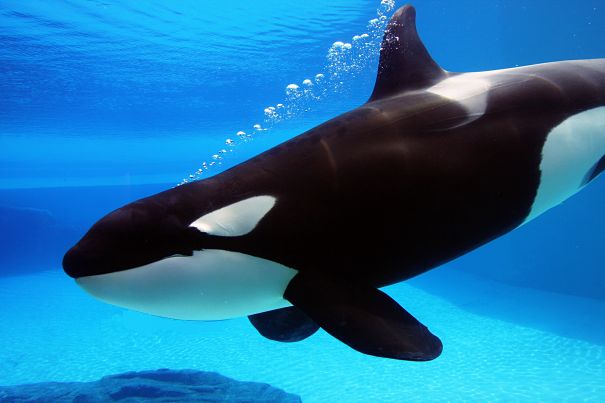
I promised a follow up, so here it is. The orca imagery (described here) worked. It did. I flew. For the first time in over a dozen years, I flew without medication. I'm very proud of this.
The take off from SEATAC was smooth, but still nerve wracking, as it was my first moment to test my new-found confidence in flying. I used good positive self-talk ("you are ok") and was fine. We did hit some turbulence near Mt. Shasta, and I pictured an orca swimming over a large rock in ocean currents. Perhaps the water gets choppier, but the orca is perfectly safe and happy swimming along.
The challenge came on the return flight. If you live in Seattle you know we had a HUGE windstorm on Sunday. Twenty thousand people lost power. The 520 bridge was closed due to wind damage. A semi truck overturned on the Tacoma Narrows bridge. It was rough. And that was when we were landing back in SEATAC.
The landing was bumpy. Very, very bumpy. When I'm swimming at Alki and a container ship goes by on the way to the Port of Tacoma, about 20 min later a HUGE wake comes in. And it is choppy. Very, very choppy. So I pictured an orca in that boat wake. Swimming along. Possibly getting pushed about. But totally safe. And happiest swimming.
I'm happy to be a flying orca!
Here's the crew that I "swam" with:
The take off from SEATAC was smooth, but still nerve wracking, as it was my first moment to test my new-found confidence in flying. I used good positive self-talk ("you are ok") and was fine. We did hit some turbulence near Mt. Shasta, and I pictured an orca swimming over a large rock in ocean currents. Perhaps the water gets choppier, but the orca is perfectly safe and happy swimming along.
The challenge came on the return flight. If you live in Seattle you know we had a HUGE windstorm on Sunday. Twenty thousand people lost power. The 520 bridge was closed due to wind damage. A semi truck overturned on the Tacoma Narrows bridge. It was rough. And that was when we were landing back in SEATAC.
The landing was bumpy. Very, very bumpy. When I'm swimming at Alki and a container ship goes by on the way to the Port of Tacoma, about 20 min later a HUGE wake comes in. And it is choppy. Very, very choppy. So I pictured an orca in that boat wake. Swimming along. Possibly getting pushed about. But totally safe. And happiest swimming.
I'm happy to be a flying orca!
Here's the crew that I "swam" with:
Monday, March 7, 2016
Open water swimming and my fear of flying!
I don't like to fly. Which is unfortunate, because I LOVE to go places. But turbulence makes me very anxious. As does being in the air. And take off. And to some extent landing. I get panicked on airplanes. I have anxiety attacks. I grab the hand of the person next to me, which is fine when it is my husband, not so cool when it is a stranger. Basically, flying sucks.
But I want to fly. I want to fly comfortably. I want to be able to go to the places I want to go and have flying simply be a mode of transportation, no more or less stressful than a train or car or bus. Sometimes stinky, sometimes delayed, but generally ok.
So I signed up for the "Fear of Flying Clinic" run by a non-profit in Seattle. The clinic is held at the Museum of Flight (or as I've come to call it-- the Museum of Anxiety) for two weekends. It culminates with a "graduation flight" together-- to Sacramento and back in a day.
So what does all this have to do with swimming? Well, my love of open water swimming came up multiple times over the course of the past two days of the clinic, and is helping me overcome the fear.
One of my biggest fears is that the plane will just fall out of the sky. Turbulence feels that way to me. I was talking to the pilot who volunteers at the clinic to teach us the science behind flight. He said that air is a fluid, just like water. The plane can't just "fall" because the air is there beneath it. That is when I started working on my airplane as orca metaphor.
The metaphor is that the airplane loves the air like an orca loves the water. It will swim (fly) along happily. Sometimes a current from a river flowing into the water will push it aside (strong side wind) and the orca will keep swimming (flying) along, adjusting its course to go where it wants to go. Sometimes there might be obstacles that create churning water (turbulence from the jet stream for example). The orca just keeps swimming (flying) along its way. It may not like the churning water, but it does not pose any type of hazard to the orca (airplane). Sometimes there may be boat wake, that causes the waves to bounce the orca around. Again, it may be uncomfortable, but it does not pose a safety hazard.
Since I experience these types of currents and wakes and waves when I swim, I can picture myself as a orca (airplane) safe and mostly happy in the water (air). I was first developing the analogy for a swimmer, but realized that the tendency for a swimmer to be high in the water, made some if the details difficult. For a water-loving mammal like the orca, the analogy can go further.
I'll get to test this analogy next weekend, at my graduation flight! Wish me happy swimming (flying)!
But I want to fly. I want to fly comfortably. I want to be able to go to the places I want to go and have flying simply be a mode of transportation, no more or less stressful than a train or car or bus. Sometimes stinky, sometimes delayed, but generally ok.
So I signed up for the "Fear of Flying Clinic" run by a non-profit in Seattle. The clinic is held at the Museum of Flight (or as I've come to call it-- the Museum of Anxiety) for two weekends. It culminates with a "graduation flight" together-- to Sacramento and back in a day.
So what does all this have to do with swimming? Well, my love of open water swimming came up multiple times over the course of the past two days of the clinic, and is helping me overcome the fear.
One of my biggest fears is that the plane will just fall out of the sky. Turbulence feels that way to me. I was talking to the pilot who volunteers at the clinic to teach us the science behind flight. He said that air is a fluid, just like water. The plane can't just "fall" because the air is there beneath it. That is when I started working on my airplane as orca metaphor.
The metaphor is that the airplane loves the air like an orca loves the water. It will swim (fly) along happily. Sometimes a current from a river flowing into the water will push it aside (strong side wind) and the orca will keep swimming (flying) along, adjusting its course to go where it wants to go. Sometimes there might be obstacles that create churning water (turbulence from the jet stream for example). The orca just keeps swimming (flying) along its way. It may not like the churning water, but it does not pose any type of hazard to the orca (airplane). Sometimes there may be boat wake, that causes the waves to bounce the orca around. Again, it may be uncomfortable, but it does not pose a safety hazard.
Since I experience these types of currents and wakes and waves when I swim, I can picture myself as a orca (airplane) safe and mostly happy in the water (air). I was first developing the analogy for a swimmer, but realized that the tendency for a swimmer to be high in the water, made some if the details difficult. For a water-loving mammal like the orca, the analogy can go further.
I'll get to test this analogy next weekend, at my graduation flight! Wish me happy swimming (flying)!
Friday, February 19, 2016
Swimming farther
Last week's experiment in body temperature helped me see that I can increase my time in the water. And if I do regular temperature checks, I'll be able to push my limits and see where the threshold for too long is. I'm sure the time to temp drop is not a linear scale, as the act of swimming generates body heat. The harder I swim the more heat I generate. So bigger waves or stronger current might actually help keep me warmer.
This did let me swim further this time. I matched my "furthest" swim at Alki! Last time I did that distance I was wearing a wetsuit. So this became my furthest swim in skin! How far? To the third set of stairs!! How far is that? Well, a half mile. I hope to keep pushing further.
Here's the map:
The red arrow marks the bath house where we start. The blue arrows point out two sets of stairs, and the green arrow marks the third set, where I turned around this time. The stairs are .1 mile, .2 mile, and .25 miles from the bath house respectively. Making this a net .5 mile swim.
The eventual goal is to swim to the light house!
Again, the red arrow marks the bath house. The green arrow is the light house, .6 miles away from the bath house for a 1.2 mile round trip. Since that is more than double what I'm swimming now, I will need to work up to it, not so much for distance, but for time in the water. I was easily doing 1.5 miles or 2 miles prior to my injury last July. I don't think it would take me long to build that distance if I weren't so worried about the cold. So I'll build slowly and see how my cold tolerance builds.
This did let me swim further this time. I matched my "furthest" swim at Alki! Last time I did that distance I was wearing a wetsuit. So this became my furthest swim in skin! How far? To the third set of stairs!! How far is that? Well, a half mile. I hope to keep pushing further.
Here's the map:
The red arrow marks the bath house where we start. The blue arrows point out two sets of stairs, and the green arrow marks the third set, where I turned around this time. The stairs are .1 mile, .2 mile, and .25 miles from the bath house respectively. Making this a net .5 mile swim.
The eventual goal is to swim to the light house!
Again, the red arrow marks the bath house. The green arrow is the light house, .6 miles away from the bath house for a 1.2 mile round trip. Since that is more than double what I'm swimming now, I will need to work up to it, not so much for distance, but for time in the water. I was easily doing 1.5 miles or 2 miles prior to my injury last July. I don't think it would take me long to build that distance if I weren't so worried about the cold. So I'll build slowly and see how my cold tolerance builds.
Monday, February 8, 2016
How Cold Is It?
After a few months of swimming from Alki with the Notorious Alki Swimmers, I've become fascinated by the issues around getting cold and warming up again. I've watched other swimmers spend 15-20 min post swim in a teeth-chattering shiver, which can't be good. My goal has been to avoid ever getting THAT cold.
I've been reading up on hypothermia and cold water, to try to get a sense of where the limits are, how long I can stay in the water and be ok. One thing I've noticed is that all the writing is about people ACCIDENTALLY ending up in cold water. Not those who intentionally do so!
My initial reading on hypothermia took me to the Mayo Clinic site and their list of symptoms. What became clear, as I was reading, was that it can be hard for the person with hypothermia to recognize it, because one of the symptoms is fuzzy headedness or confusion. This is scary, so I can get this thing, and not even know I have it!
All this made me slightly anxious that I was taking a foolish risk with my swimming. At the same time, I'm one of about 20 people who do it weekly, and many of the others stay in the water a LOT longer than I do.
So where is the line? How will I know if I'm getting too cold? Can I know when I'm IN the water, or will I only know with hindsight? Most websites on the topic says that hypothermia sets in when the body temperature is 95* (F) or lower. (There is mild, moderate and severe hypothermia, but I'll talk about those some other time.
My research took me to the LoneSwimmer blog, where the author has asked these questions and attempted to answer them with science. The chart below is from that blog and provided me some comfort.
I've been reading up on hypothermia and cold water, to try to get a sense of where the limits are, how long I can stay in the water and be ok. One thing I've noticed is that all the writing is about people ACCIDENTALLY ending up in cold water. Not those who intentionally do so!
My initial reading on hypothermia took me to the Mayo Clinic site and their list of symptoms. What became clear, as I was reading, was that it can be hard for the person with hypothermia to recognize it, because one of the symptoms is fuzzy headedness or confusion. This is scary, so I can get this thing, and not even know I have it!
All this made me slightly anxious that I was taking a foolish risk with my swimming. At the same time, I'm one of about 20 people who do it weekly, and many of the others stay in the water a LOT longer than I do.
So where is the line? How will I know if I'm getting too cold? Can I know when I'm IN the water, or will I only know with hindsight? Most websites on the topic says that hypothermia sets in when the body temperature is 95* (F) or lower. (There is mild, moderate and severe hypothermia, but I'll talk about those some other time.
My research took me to the LoneSwimmer blog, where the author has asked these questions and attempted to answer them with science. The chart below is from that blog and provided me some comfort.
Alki is usually around 10* C. So this gives me a safe zone of just under an hour in the water, and a marginal zone of three hours. That would expand my swim range significantly, from the current 20-25 min.
The author of LoneSwimmer also pointed me to research that shows that there is no long-term negative effect of MILD hypothermia (the author has an in depth discussion of this topic as well). This may give me permission to push a bit further.
But the question remains, am I getting hypothermia on my current swims?
So I took a thermometer with me to Alki last week. Here's what I learned:
Before the swim (at home) temp 97.3 (yes, this is normal for me, I'm always a bit low)
Before the swim (at the beach) temp 96.8.
After the swim (at the beach) temp 95.3.
After the swim (at home, about 45 min later) temp 97.3.
What does this all mean?
First, I lost about a degree and a half in the water for 20 min or so (I swam to the second set of stairs, and there was little to no current). With a low "normal" body temperature, I'm not sure hypothermia, for me, will be at the precise 95 degrees. I'm guessing that it has more to do with lowering the body temp 3.6 degrees (from 98.6 to 95) then a set 95. But this is just a guess, I'd love to find research that supports it. If I could lose up to 3.5 (for rounding sake) degrees and still be ok, then a body temp as low as 93.8 would put me into the hypothermic zone.
Second, I'm losing a half a degree just between home and the beach. We often spend a bit of time hanging out waiting for people to gather and working up the nerve to get cold. My body is cooling in that time. I may want to work even harder to stay warm in that phase.
Lastly, I rewarmed by the time I finished the drive home. With no adverse effect.
For this to go from anecdote to data, I'll need to add some data points. Will continue doing the temp checks, before and after swimming for a few weeks. Stay tuned for updates.
Labels:
alki,
cold,
hypothermia,
Notorious Alki Swimmers,
temperature
Wednesday, January 27, 2016
CSO: Or why I didn't swim this weekend
I live in Seattle and swim in Puget Sound (or Lake Washington). Recently I've been swimming most often out of Alki beach in West Seattle.
Seattle has a dirty little secret. That is, with each large rain storm, the city releases thousands of gallons of sewage into the waterways, both Puget Sound and Lake Washington. This is done to keep the sewage from backing up into the streets when the storm drains are full. That's, on balance, probably a good idea.
However, I don't especially like swimming in raw sewage. And so, when the rains are heavy, I check the city website for information on if the Combined Sewage Outflows (CSOs) have fired off. If they have, I don't swim.
Here's the chart from this weekend, with my swim point marked with an arrow:
One might argue that the CSOs near my swim site weren't dispensing, so why not swim? Well, I once got VERY sick after a swim with that logic. So these days, a red or yellow CSO means no swim for me.
I hope to be back this weekend. And, as the days are getting (slightly) longer, perhaps an after-work swim will be back on the agenda soon!
Seattle has a dirty little secret. That is, with each large rain storm, the city releases thousands of gallons of sewage into the waterways, both Puget Sound and Lake Washington. This is done to keep the sewage from backing up into the streets when the storm drains are full. That's, on balance, probably a good idea.
However, I don't especially like swimming in raw sewage. And so, when the rains are heavy, I check the city website for information on if the Combined Sewage Outflows (CSOs) have fired off. If they have, I don't swim.
Here's the chart from this weekend, with my swim point marked with an arrow:
One might argue that the CSOs near my swim site weren't dispensing, so why not swim? Well, I once got VERY sick after a swim with that logic. So these days, a red or yellow CSO means no swim for me.
I hope to be back this weekend. And, as the days are getting (slightly) longer, perhaps an after-work swim will be back on the agenda soon!
Monday, January 11, 2016
Getting Warmer...
The plan for this week's swim was to "hyper warm" before the swim and see if that helped with my time in the water. The short answer is, it did!
Here's what I did... Prior to swimming I tried to keep my body warm. This started when I got out of bed, immediately putting on sweatpants and a sweatshirt, even though the house was comfortable. Then I kept the heat up in the car on the way to the swim, and wore a puffy jacket and hat until the moment I put on my swim gear.
That's me under the arrow. You can see in the pre-swim group photo I'm still wearing my hat and coat. I was nice and comfortable.
For the swim I wore two caps (one silicone, one latex, that's just what I had on hand) and my booties and gloves. I swam for 25 min or so, to the second stair case. And I felt comfortable the whole time (OK, the cold side of comfortable, but still ok).
My one mistake came near the end of the swim. I started chatting with another swimmer and just gently paddling. This got me COLD. My fingers started chilling first. I tried to make fists inside my gloves and ended up removing the gloves, which just made my fingers colder.
For the first time, I did have a small amount of the teeth chattering after the swim. This only lasted about 30 seconds and I was able to control it. But that is the threshold I don't want to cross. I think I would have been ok, and not had the chatters, if I'd not done the slow paddle chat and instead finished swimming. I'll know for next time!
Air Temp- 40. Water Temp- 48.
Here's what I did... Prior to swimming I tried to keep my body warm. This started when I got out of bed, immediately putting on sweatpants and a sweatshirt, even though the house was comfortable. Then I kept the heat up in the car on the way to the swim, and wore a puffy jacket and hat until the moment I put on my swim gear.
That's me under the arrow. You can see in the pre-swim group photo I'm still wearing my hat and coat. I was nice and comfortable.
For the swim I wore two caps (one silicone, one latex, that's just what I had on hand) and my booties and gloves. I swam for 25 min or so, to the second stair case. And I felt comfortable the whole time (OK, the cold side of comfortable, but still ok).
My one mistake came near the end of the swim. I started chatting with another swimmer and just gently paddling. This got me COLD. My fingers started chilling first. I tried to make fists inside my gloves and ended up removing the gloves, which just made my fingers colder.
For the first time, I did have a small amount of the teeth chattering after the swim. This only lasted about 30 seconds and I was able to control it. But that is the threshold I don't want to cross. I think I would have been ok, and not had the chatters, if I'd not done the slow paddle chat and instead finished swimming. I'll know for next time!
Air Temp- 40. Water Temp- 48.
Subscribe to:
Comments (Atom)